Misconception: A multi‑chain wallet is just a prettier MetaMask — why transaction simulation actually matters
Many DeFi power users assume that any modern browser wallet is interchangeable: it stores keys, prompts to sign, and shows balances — end of story. That assumption flattens an important dimension of risk. In practice the difference between “blind signing” and “simulated signing” is not cosmetic; it changes the set of feasible attacks and the user’s ability to make informed, conditional decisions. This matters especially for heavy DeFi users who route trades across chains, grant approvals to contracts, or operate from institutional accounts where a single mis-signed transaction can cascade into large dollar losses or operational headaches.
This commentary unpacks how transaction simulation — as implemented by wallets such as the Rabby Chrome extension — reconfigures the trade-offs that users face. I explain the mechanism, compare alternatives, surface limits and failure modes, and give concrete decision heuristics for when simulation reduces real risk and when it gives only a false sense of security.
How transaction simulation works (mechanism, not marketing)
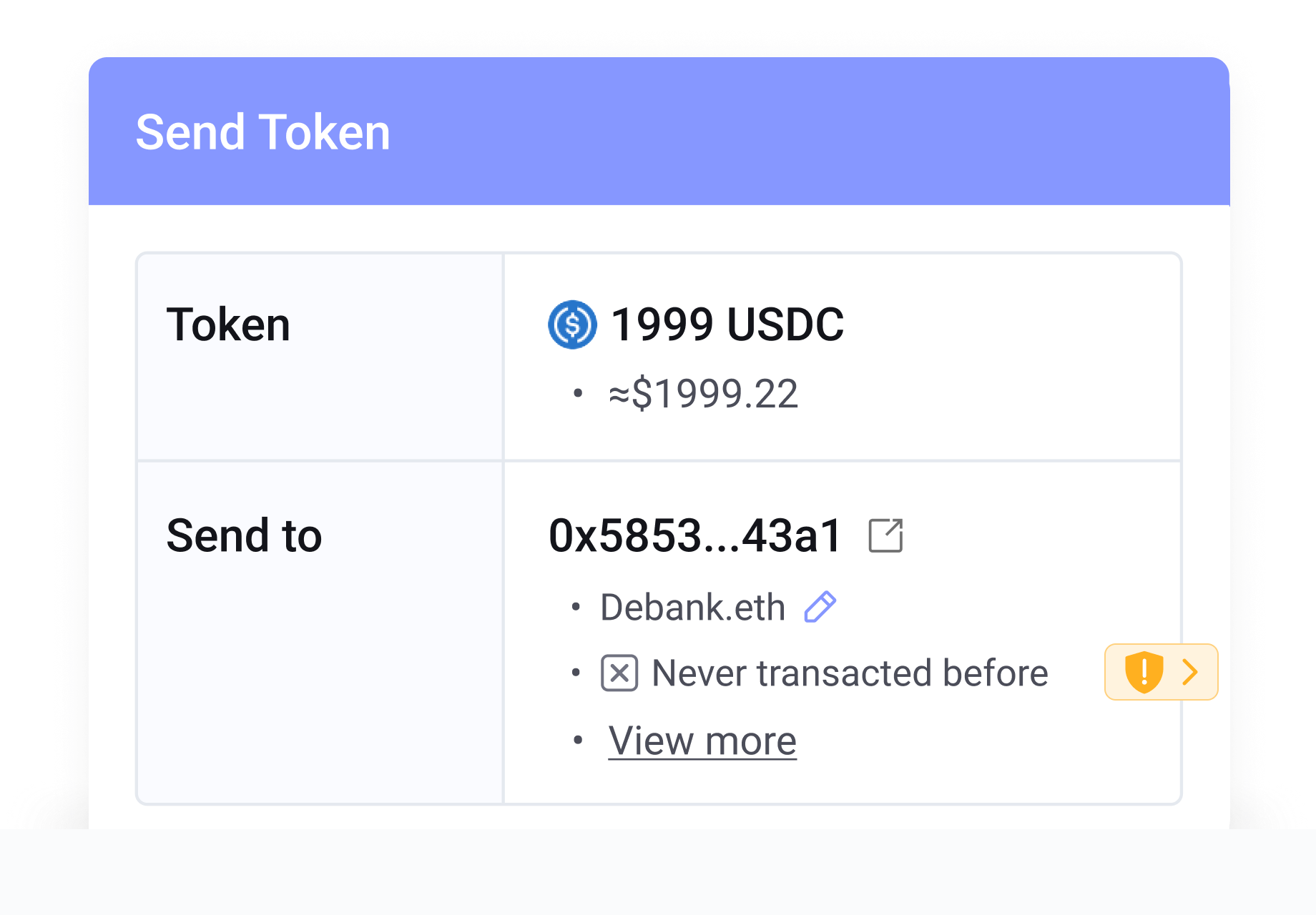
At its core, transaction simulation runs the transaction payload through a local or remote EVM execution environment before it is submitted. The wallet constructs the exact call data you are about to sign, then queries a node or simulation engine to compute the state transition without broadcasting it. The result: estimated token balance deltas, gas consumption, and whether the target contract calls known risky addresses or non-existent recipients. That is what Rabby surfaces to users — explicit estimated balance changes and fee costs — rather than an opaque “Approve” dialog.
This step prevents blind signing by replacing ambiguity with a concrete outcome preview. Mechanistically, simulation depends on two things: (1) accurate state read from a node (token balances, allowance state, contract bytecode), and (2) deterministic execution of the EVM under those reads. If either read is stale or the node is compromised, the simulation can be misleading. Good wallets mitigate this by using well‑maintained public and private RPC endpoints and by flagging when reads are uncertain; open‑source projects can be audited to verify these choices.
Why simulation matters to DeFi power users
For frequent traders and liquidity providers the operational value is concrete. Consider three common scenarios: token approvals, multi‑hop swaps across chains, and smart‑contract interactions with composable protocols. Each carries a narrow technical failure mode that simulation helps surface: a malicious contract that immediately transfers approved tokens; a router that will sweep funds due to a slippage mismatch; or a cross‑chain call that will fail because the destination chain lacks gas. Seeing exact token deltas and estimated fees before signing converts those failure modes from surprises into decisions: reduce allowance, change route, or top up gas first.
Rabby’s suite of pre‑transaction risk scanning, approval revocation, and cross‑chain gas top‑up are designed to work together. Simulation tells you what will happen; a revocation tool lets you undo past broad approvals; the gas top‑up lets you resolve execution failures on remote chains. That combination reduces operational friction for multi‑chain activity — but it is not a panacea. Each feature reduces certain classes of human error and protocol risk while leaving others untouched, which is an important distinction for power users to internalize.
Comparing Rabby with common alternatives: trade-offs and fit
MetaMask, Trust Wallet, and Coinbase Wallet dominate the user base because they are widely integrated and familiar. Where Rabby differentiates itself is explicit simulation, automatic network switching, and a set of built‑in security utilities. Practically that means:
- MetaMask: excellent ecosystem reach; lower friction for basic use. Trade-off: by default it lacks a built‑in transaction preview showing precise token deltas, so advanced users often rely on external explorers or manual decoding.
- Trust Wallet and Coinbase Wallet: strong mobile experience and fiat onramps (notably absent in Rabby). Trade-off: convenience for retail on‑ramps versus the deeper pre‑signing security controls that Rabby offers.
- Rabby: focused on simulation, approval management, and multi‑chain workflows. Trade-off: fewer in‑wallet fiat rails and no native staking dashboard; gains for DeFi power users come from clearer pre‑transaction visibility and automation (automatic network switching, cross‑chain gas top‑up).
For an institutional user or a frequent DeFi trader who values deterministic previews and revocation workflows, the balance often favors a wallet with simulation and hardware integration. Rabby’s compatibility with Ledger, Trezor, and multisig systems like Gnosis Safe means you can combine simulation with higher‑assurance signing policies — a key consideration for Treasury teams operating from the US or regulated entities weighing operational controls versus user experience.
Where simulation breaks down: limitations and failure modes
Simulation reduces but does not eliminate risk. Important boundary conditions:
1) Stale state or oracle dependency. If your simulation uses an RPC node that is behind or an oracle that will update between simulation and broadcast, the final outcome may differ. That matters especially during high volatility or fast front‑running windows.
2) Reentrancy and miner/MEV behavior. Simulations run in a neutral execution context. They cannot guarantee the ordering or front‑running behavior that occurs in mempools. An observed safe delta may be invalidated by MEV extraction between simulation and inclusion.
3) Contract upgrades and proxy patterns. Simulating a call against a proxy can show one behavior while a subsequent upgrade to the target implementation can enable different logic. Wallets help by flagging known upgradeable patterns, but a simulation is still a point‑in‑time check.
4) Human interpretation. Presenting precise numbers is necessary but not sufficient. If a UI shows token deltas but hides that an approval is “infinite” or that a trade uses a third‑party router, users can still click through. Tools like revocation panels and clearer labelling are essential complements.
Practical heuristics for DeFi power users
Translate simulation into safer decisions with a few rules of thumb:
– Treat each simulation as a conditional decision: if the preview shows a small balance delta but a large allowance reset, pause and consider limiting the allowance to the exact amount. Rabby’s approval revocation makes that easier after the fact, but prevention is better.
– Use hardware wallets for signing high‑value transactions even when simulation looks clean. Simulation changes the information set; a hardware device changes the trust anchor.
– For cross‑chain interactions, simulate on the destination chain when possible and use the cross‑chain gas top‑up proactively. It’s cheaper to pay for a small gas top‑up than to reroute or suffer failed L2 withdrawals.
– Maintain multiple RPC endpoints in your wallet configuration or rely on a trusted provider to reduce the chance of stale state reads. Open‑source wallets make these choices auditable.
What to watch next: signals and conditional scenarios
Watch for three signals that will change where simulation matters most. First, increasing MEV sophistication: if generalized sandwiching and bundle extraction become cheaper relative to fees, the value of simulation will be bounded by execution-order risk rather than pre‑sign visibility. Second, richer on‑chain programmability (e.g., native cross‑chain message formats) will make simulations more complex and more valuable if they can model cross‑domain semantics. Third, regulatory pressure in the US around custodial operations could push more institutions to prefer non‑custodial wallets with strong pre‑transaction controls and multisig integrations — a tailwind for wallets that marry simulation with enterprise signing solutions.
None of these are certainties; they are conditional scenarios. The practical implication is simple: simulation is most useful now when used as one control in a layered defense — not as the only control.
For readers who want to inspect a concretely implemented workflow and compare its UX and controls, see this summary of the rabby wallet experience and how it integrates simulation, revocation, and cross‑chain plumbing into a single extension.
FAQ
Does transaction simulation remove the need for hardware wallets?
No. Simulation improves information available before signing but does not change who holds the signing key. Hardware wallets remain the stronger trust anchor for high‑value or institutional transactions because they prevent key extraction and reduce the attack surface at signing time. Use both: simulation for visibility, hardware signing for assurance.
Can simulation detect malicious contracts or past exploits?
Simulation can flag interactions with known compromised contracts (if the wallet’s security database includes them) and can show suspicious token deltas. However, it cannot retroactively protect against zero‑day logic in a new malicious contract unless signatures or static analysis reveal red flags. Simulation reduces surprise, but it requires up‑to‑date threat intelligence and user attention.
How reliable are gas and balance estimates from simulation?
Estimates are as reliable as the RPC node and the assumed mempool conditions. They are usually accurate in normal conditions but can diverge during congestion or when the transaction depends on off‑chain or time‑sensitive state. Treat estimates as guidance, not absolute guarantees.
Is simulation only useful for advanced users?
No. While advanced users extract more operational value, simulation helps any user avoid costly mistakes — especially with approvals and token swaps. The real challenge is designing UI that turns simulation outputs into clear, actionable choices without overwhelming users with low‑value data.
Decision takeaway: if you operate across multiple EVM chains and sign complex DeFi transactions from the US, prioritize a wallet that (a) surfaces deterministic transaction previews, (b) integrates with hardware and multisig signing, and (c) offers approval management. Simulation is a powerful information control, but it should be combined with infrastructure choices (trusted RPCs, hardware keys) and operational habits (limit allowances, pre‑fund gas) to convert information into reduced loss exposure.